

CUET PG Study Plan 2027: The CUET PG 2026 exam is already done and dusted — it ran from March 6 to March 27, 2026. So if you’re mapping out a study plan today, you’re preparing for the CUET PG study plan 2027.
You’re preparing for CUET PG 2027. NTA typically drops the notification about a year ahead of the exam window — expect the CUET PG 2027 bulletin around December 2026, with the actual test likely landing in March 2027. This guide skips the fluff and gives you the real exam pattern, the actual 90-minute format, and a study plan you can start using today — months before NTA even opens its portal.
Most guides recycle last year’s dates and call it “prep advice.” We’re not doing that. Everything below is checked against NTA’s own CUET PG 2027 data — the most recent real cycle — because the pattern rarely changes much year to year, but the timeline does. Let’s get into it.
Still Searching “CUET PG Study Plan 2027”? Read This First
A lot of students type “CUET PG study plan 2027” into Google out of habit, or because coaching ads keep using the old year. Fair enough — exam names are confusing. Here’s the quick clarification, so you don’t waste a week studying against the wrong calendar.
- CUET PG 2026 was conducted for admissions into the 2026–27 academic session. That window has closed.
- CUET PG 2027 will decide admissions for the 2027–28 academic session. This is the exam you’re actually training for.
- The exam pattern almost never changes drastically between cycles, so old CUET PG exam guides are still useful for structure — just not for dates.
One student we know, preparing for an MA in Political Science, spent three weeks last year revising against a leaked “2025 schedule” screenshot from Telegram. She missed the real correction window entirely. Don’t be her. Bookmark exams.nta.nic.in/cuet-pg and check it monthly starting October 2026.
Why CUET PG Still Matters for Your Master’s Admission
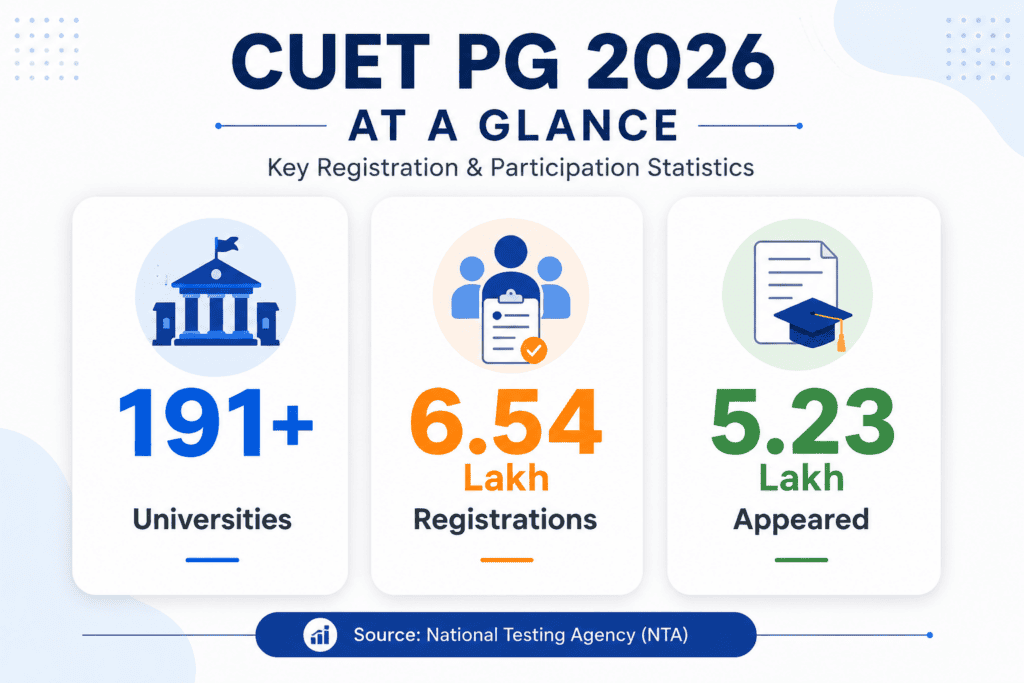
CUET PG stopped being a “niche exam” the moment it started deciding seats for over 191 universities — central, state, and private — spanning everything from MA and MSc to M.Com, MBA, and MCA. The numbers tell their own story: 6.54 lakh candidates registered in the most recently completed cycle, and 5.23 lakh actually showed up to write it. That’s not a typo. That’s nearly the population of a mid-sized Indian city, all competing for the same batch of PG seats. Scattershot prep simply doesn’t survive contact with numbers like that.
Here’s the real shift, though — and it’s more than a logistics upgrade. CUET PG didn’t just add one more exam to the calendar; it quietly retired dozens of separate university-level entrance tests and replaced them with a single common gate. One paper instead of five. Sounds like a relief, right? It is — but it comes with a catch. A test built to be fair to everyone can’t afford to be too clever for anyone. That’s exactly why the syllabus hugs your undergraduate curriculum so closely instead of wandering off into postgraduate-only trivia nobody covered in class.
CUET PG Eligibility Criteria (2027 Expected)
NTA hasn’t dropped the CUET PG 2027 bulletin yet. But if the last few cycles are any indication — and they usually are — the eligibility skeleton stays put:
- A Bachelor’s degree (or its recognised equivalent) from a UGC-recognised university, generally with 50% aggregate as the floor. That number shifts a little depending on the subject and the university, so don’t treat it as gospel — check the specific programme once applications go live.
- No age ceiling, no age floor, for most CUET PG programmes. Whether you’re 22 or 42, the exam doesn’t matter.
- Final-year undergrads get in provisionally, on the condition they wrap up their degree before the admission process closes.
Waiting for the bulletin to figure out where you stand is the slow way to do this. If your aggregate is sitting right on that 50% line, start watching your final-year internal assessments now — not in December, when there’s nothing left to fix.
CUET PG Exam Pattern 2027 (Quick Answer)
CUET PG is a computer-based test (CBT) conducted by the National Testing Agency. Based on the CUET PG 2026 cycle — the most recently completed exam — here’s what the pattern looked like, and what you should prepare for the CUET PG study plan 2027.
CUET PG Exam Duration
Each CUET PG paper runs for 90 minutes, containing 75 multiple-choice questions. That’s 1.2 minutes per question on average — tight, but manageable if your concepts are solid rather than half-memorized.
Marking Scheme
- +4 marks for every correct answer
- −1 mark for every incorrect answer
- No marks for unattempted questions
This negative marking is exactly why blind guessing tanks scores. A 40% guess-accuracy rate on 20 random guesses can cost you more marks than it earns.
Subjects Covered
CUET PG 2026 spanned 157 subject-specific papers across nearly 198 universities — spread over 15 exam days and packed into 44 shifts. That’s not a typo. NTA genuinely ran this thing like a logistics operation. Candidates could pick up to four papers, depending on what they’re chasing — MA, MSc, MCom, MBA, MCA, take your pick. And here’s the part that should make you exhale: the syllabus for each paper comes straight from the undergraduate curriculum. No mysterious PG-only syllabus hiding somewhere. You’ve already studied this. You just forgot half of it.
- Quick takeaway: 75 questions. 90 minutes. +4 for correct, −1 for wrong. Undergraduate syllabus, nothing invented. That’s the whole exam, in one breath.
CUET PG 2027 Important Dates (Expected)
NTA hasn’t dropped the official CUET PG 2027 bulletin yet — it rarely shows up this early. But going by the agency’s last few cycles, here’s what the timeline will probably look like:
| Event | Expected Window |
|---|---|
| Information bulletin release | December 2026 |
| Application form opens | Second week of December 2026 |
| Application deadline | January 2027 |
| Correction window | January 2027 |
| City intimation slip | Late February 2027 |
| Admit card release | First week of March 2027 |
| CUET PG 2027 exam | March 2027 (second week onward) |
| Result declaration | April–May 2027 (estimated) |
Treat these as planning anchors, not gospel — NTA can shift dates by a week or two. But this table is enough to reverse-engineer your prep calendar, which is exactly what the next section does.
Expected CUET PG 2027 Application Fee
Based on the 2026 cycle, application fees varied roughly between ₹1,400 and ₹7,000, depending on your category, nationality, and how many test papers you selected. Budget for the higher end if you’re applying for multiple subject papers — it adds up faster than most first-time applicants expect.
Self-Study vs Coaching: What Actually Works for CUET PG
This question comes up constantly, and the honest answer is: it depends less on coaching and more on discipline.

Cracking CUET PG without coaching is genuinely achievable — plenty of candidates do it every year — but it demands a structure you’d otherwise get handed to you in a classroom.
| Factor | Self-Study | Coaching |
|---|---|---|
| Cost | Low (books + mocks) | Higher (fees vary widely) |
| Flexibility | High — study on your schedule | Fixed batch timings |
| Accountability | Self-driven, needs discipline | Built-in through tests and deadlines |
| Best suited for | Confident, self-motivated learners | Students who need structure or are weak in specific subjects |
If you go the self-study route, the fix for “accountability” is simple: commit to a fixed weekly mock schedule and treat it like a non-negotiable appointment, the same way you’d treat a coaching class you’d paid for.
How to Prepare for CUET PG — A Step-by-Step Study Plan
Forget the generic “study six hours a day” advice floating around YouTube. It doesn’t work, and honestly, it never did. A CUET PG study plan actually works when it’s split into three phases, each doing one job and one job only. Here’s how to structure roughly five to six months of prep, working backwards from an expected March 2027 exam date.
Phase 1 (Months 1–2): Build the Base
This phase isn’t about testing yourself. It’s about relearning what you already forgot. You’re rebuilding your entire undergraduate syllabus from the ground up — because CUET PG doesn’t chase obscure trivia, it hammers core concepts, again and again.
- Pull out your UG syllabus — semester notes, NCERT-equivalent texts, whatever you’ve got — and map it against NTA’s official CUET PG subject-wise syllabus PDF.
- Give each unit one week. Read it, take notes, then immediately attempt 15–20 MCQs before you move on. Don’t skip this part.
- Start a “weak topics” notebook. Every single time a concept trips you up, it goes in there. Trust the process — you’ll thank yourself in Phase 3.
- Taking the General Test paper too (common if you’re eyeing MBA or MCA seats)? Start reasoning and current-affairs practice from day one. These skills don’t build overnight; they compound slowly, like interest.
Phase 2 (Months 3–4): Practice Hard
The goal flips now. Learning takes a back seat. Speed and accuracy take the wheel.
- One full-length, subject-specific mock test every week. Strictly timed. 90 minutes, no exceptions.
- After every mock, spend at least 45 minutes on review — and not the lazy kind. Don’t just check which option was correct; dig into why you got it wrong.
- Start solving previous years’ CUET PG question papers for your subject. Here’s the thing though — pattern recognition beats sheer volume every time.
- Build what I call “4-mark discipline”: only attempt a question if you’re at least 70% sure. That one habit alone protects your score from the negative marking trap.
Phase 3 (Final 30 Days): Revise and Simulate
Pure consolidation. Zero new topics. None.
- Revisit that “weak topics” notebook daily. This one habit can lift your score more than any last-minute chapter cramming ever will.
- Two to three full mocks a week, under real exam-day conditions — same time slot, phone away, no pause button, no shortcuts.
- Sleep and diet matter way more than people like to admit. A tired brain fumbles simple questions under time pressure. That’s not a knowledge gap — that’s just fatigue talking.
- Final week? Stop attempting new mocks entirely. Switch to flashcards and formula sheets, and nothing else.
One thing worth flagging: NTA’s own 2026 notice confirmed the exam ran 90 minutes per shift with a straightforward +4/−1 marking scheme, which is exactly why the “70% confidence” rule in Phase 2 matters so much — guess wrong too often and negative marking eats your score alive.
Subject-Wise CUET PG Preparation Tips
Different postgraduate streams need slightly different approaches. A few examples:
- Humanities and Social Sciences (MA English, Political Science, History): Skip the date-mugging. CUET PG likes to test whether you can apply a theory, not recite it — think “which framework explains this situation” rather than “who said what in which year.”
- Commerce (MCom): Accounting standards, financial management — these punish procrastinators. You can’t cram speed. Ten minutes of daily numericals will beat a six-hour weekend binge, every single time.
- Sciences (MSc Physics, Chemistry, Botany, Zoology): Numericals and diagrams carry the weight here. And a pattern worth noticing — past papers reuse the format of a question even when the numbers inside it change. Learn the shape, not just the answer.
- MBA/MCA aspirants: The General Test isn’t a formality — it decides a real chunk of your score. Split your prep day in half: domain knowledge on one side, quant, reasoning, and current affairs on the other.
- Computer Applications (MCA): Don’t write off programming logic just because it’s MCQ-based. The exam wants to know if you can trace a code snippet in your head, line by line — not whether you can code it from scratch.
- Language papers (English, Hindi, others): Grammar and comprehension outrank author trivia here, by a wide margin. Read one unseen passage a day, answer the inference questions on it. Small habit. Directly transfers to exam day.

A quick real-world example: a Delhi-based MCom aspirant we know rebuilt her entire accounting section score by switching from passive reading to solving 20 numericals daily, timed at under two minutes each. Her mock scores in that section jumped by nearly 30% over six weeks — not because she learned new formulas, but because speed under pressure was the actual gap, not knowledge.
CUET PG Exam Guide: Books and Resources That Actually Help
Skip the temptation to buy five guidebooks for the same subject — it fragments your revision. Instead:
- Use your UG-level NCERT or equivalent state board textbooks as the primary base for concept-building.
- Pick one subject-specific CUET PG guidebook with previous years’ papers and full-length mocks — publishers like Arihant and Oswaal both cover major CUET PG subjects.
- Use NTA’s official mock test link (released closer to the exam) for the most authentic simulation of the actual interface.
- For the General Test, a standard reasoning and current-affairs digest (updated monthly) works better than a static book that goes stale in six months.
Mistakes That Sink CUET PG Scores (And How to Dodge Them)
- Ignoring negative marking: Guessing on every unattempted question at the end is a losing strategy under +4/−1 scoring. Only guess when you can eliminate at least two options.
- Starting mocks too late: Students who begin full-length mocks only in the last two weeks consistently underperform — timing under real pressure is a trained skill, not an instinct.
- Overloading on new material near the exam: Cramming unfamiliar chapters in the final week usually replaces confidence with confusion.
- Skipping the reporting-time instructions: Every year, some candidates lose their exam slot over late arrival or missing ID proof. Read your admit card twice, not once.
- Treating all four subject papers equally: If you’ve selected multiple test papers, rank them by your strength and allocate prep time proportionally — don’t split time equally if one paper matters more for your target university.
- Not simulating the actual CBT interface: Reading on paper and answering on a screen with an on-screen timer feel completely different. Use NTA’s official mock test link at least a few times before exam day so the interface itself isn’t a source of stress.
Conclusion
If you searched “CUET PG study plan 2026,” here’s the blunt truth: that train left the station months ago. CUET PG study plan 2027 is the one that actually matters now. And here’s the good news — the pattern barely changes year to year. 90 minutes. 75 MCQs. +4 for a correct answer, −1 for a wrong guess. Undergraduate-level questions, not some mysterious postgrad syllabus nobody’s seen. Which means you don’t need NTA’s official bulletin to start. You need a plan, a timer, and this week.
Spend the next two months rebuilding your UG basics — properly, not skimming. Then flip the switch: weekly timed mocks, no exceptions. The last 30 days belong to revision alone; no new topics, no last-minute panic-learning. Bookmark this page, come back once NTA drops the CUET PG 2027 dates, and take your first mock this week. Not in December. Not “after Diwali.” This week.
FAQs
Q1: What is the CUET PG exam duration?
90 minutes per paper. 75 MCQs. That’s it — no hidden sections, no surprise essay.
Q2: What is the CUET PG exam pattern for 2027?
Going by the 2026 cycle, expect the same skeleton: computer-based test, 75 MCQs, 90 minutes, +4/−1 marking, questions pulled from your subject’s undergraduate curriculum. NTA has kept this format stable for two straight years now, so a major overhaul before 2027 seems unlikely — though the official bulletin always has the final word.
Q3: When will CUET PG 2027 be conducted?
If NTA sticks to its recent rhythm, expect the information bulletin around December 2026 and the exam itself in March 2027. That’s roughly a three-month runway between bulletin and exam day — plan your final mock-test phase around that window.
Q4: How do I prepare for CUET PG without coaching?
Thousands do it every year, honestly. A three-phase self-study plan works: rebuild your UG syllabus first (no shortcuts here), move into weekly timed mocks once the basics are solid, then shut the books on new content and revise hard in the final month. What separates a 280+ scorer from someone who barely clears cutoff usually isn’t the coaching brand on their hoodie — it’s whether they actually timed their mocks like the real exam.
Q5: Is the CUET PG syllabus different from my undergraduate syllabus?
No. Your subject paper mirrors your UG-level curriculum — the same concepts you (hopefully) studied in your bachelor’s degree, just tested with a sharper, exam-ready lens.
Q6: How many subjects can I choose in CUET PG?
Up to four test papers, depending on which postgraduate programmes you’re eyeing. Choose wisely though — more papers means more prep hours split thinner, and burnout is real.
Q7: What is the CUET PG application fee expected to be in 2027?
Based on the 2026 cycle: ₹1,400 for General category candidates covering up to two papers, with ₹700 added for each extra paper. OBC-NCL/EWS candidates paid around ₹1,200, and SC/ST/Third Gender candidates around ₹1,100. Candidates applying from outside India paid a flat ₹7,000 for the first two subjects. Expect similar numbers for 2027, though NTA could revise these once the official bulletin lands.