

If you’re searching for the latest Delhi NCR college ranking 2027 after 12th or just got over, and suddenly it’s the only question anyone asks you. “So where are you applying?” If the best colleges in Delhi NCR are on your radar, good news — you’re not short on options. This region packs in some of the country’s most respected names, central universities, IITs, plus a fair few private campuses that don’t get talked about enough but genuinely deserve to be. The catch?
There are hundreds of best UG colleges Delhi NCR spread across Delhi, Noida, Gurugram, Faridabad, Ghaziabad. Picking one can feel a bit like walking into a restaurant with a 400-item menu and zero idea what you actually want.
So let’s cut through that—no brochure language, no vague promises — just what you actually need to know.
Why Everyone’s Fighting for a Seat in Delhi NCR
Delhi isn’t only India’s political capital. Somewhere along the way it also turned into the country’s academic capital, and that wasn’t luck. IIT Delhi and DTU pull in engineering hopefuls from practically every state. Delhi University alone has over 90 affiliated colleges, and every year lakhs of students apply, knowing full well most of them won’t get in.
Add AIIMS Delhi for medicine, Jamia Millia Islamia, JNU, and a fast-growing list of private universities across Noida and Gurugram, and it starts to make sense why students pack their bags in Bihar, UP, Rajasthan — sometimes much farther — just to study here.
There’s a practical reason too, and it’s a big one. Delhi NCR is where the jobs are. Internships, part-time gigs, corporate offices, government headquarters — none of it’s far away. Studying somewhere the opportunities already exist, instead of somewhere you’ll have to travel to later, gives students a real edge. Not every college town in India can say that.
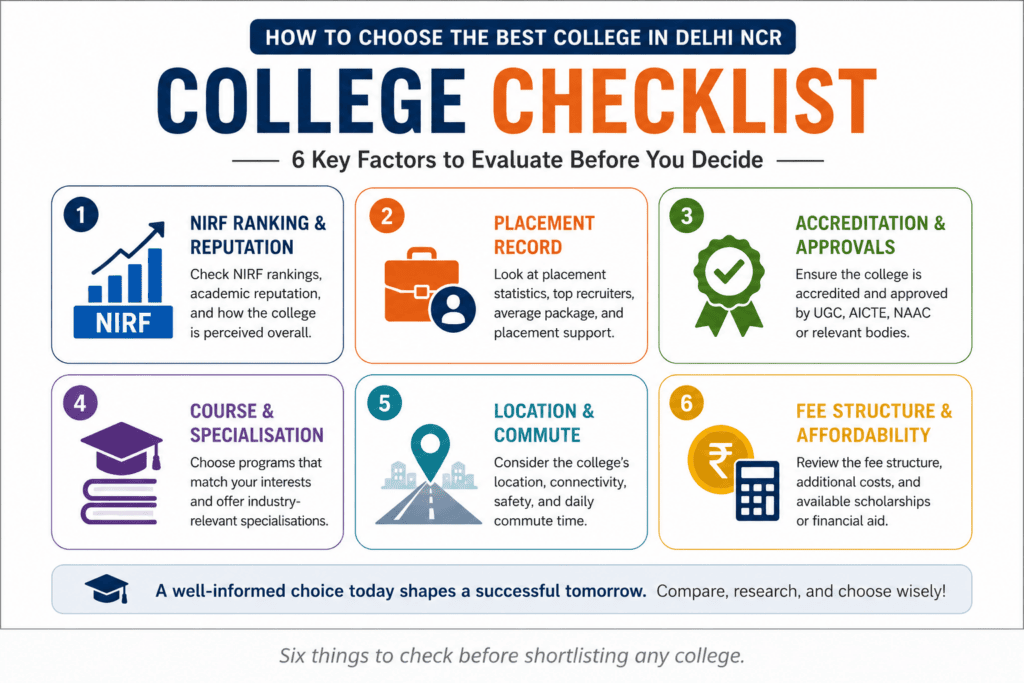
What Should You Actually Look For in a College?
Before jumping into any top colleges Delhi NCR list or best colleges near me Delhi, pause for a second. Rankings matter, sure, but they’re not the whole story. A college that’s perfect for your friend might be completely wrong for you. Here’s what actually deserves your attention:
- NIRF Ranking – The National Institutional Ranking Framework is released every year by the Ministry of Education, and it’s one of the more trustworthy benchmarks out there. It looks at teaching quality, research output, graduation outcomes, and more.
- Placement Record – Don’t just look at the “highest package” number colleges love flashing on their websites. Check the average package. That number tells you what most students actually walk away with.
- Accreditation – NAAC A+ or A++ grading, UGC recognition, and relevant professional body approvals (like Bar Council for law, or MCI/NMC for medicine) aren’t optional checkboxes. They matter for your degree’s credibility.
- Course Specialisation – A college ranked #1 overall might not have the strongest programme in the exact subject you want. Dig deeper.
- Location and Commute – This one gets ignored way too often. A “best college near me Delhi” exists for a reason — daily commute time adds up fast, and it genuinely affects how much energy you have left for studying.
- Fee Structure – Government colleges are cheaper, obviously. But private universities often bundle in infrastructure, industry tie-ups, and placement support that can justify the cost, depending on your goals.
Best Colleges in Delhi NCR: Top Picks by Category
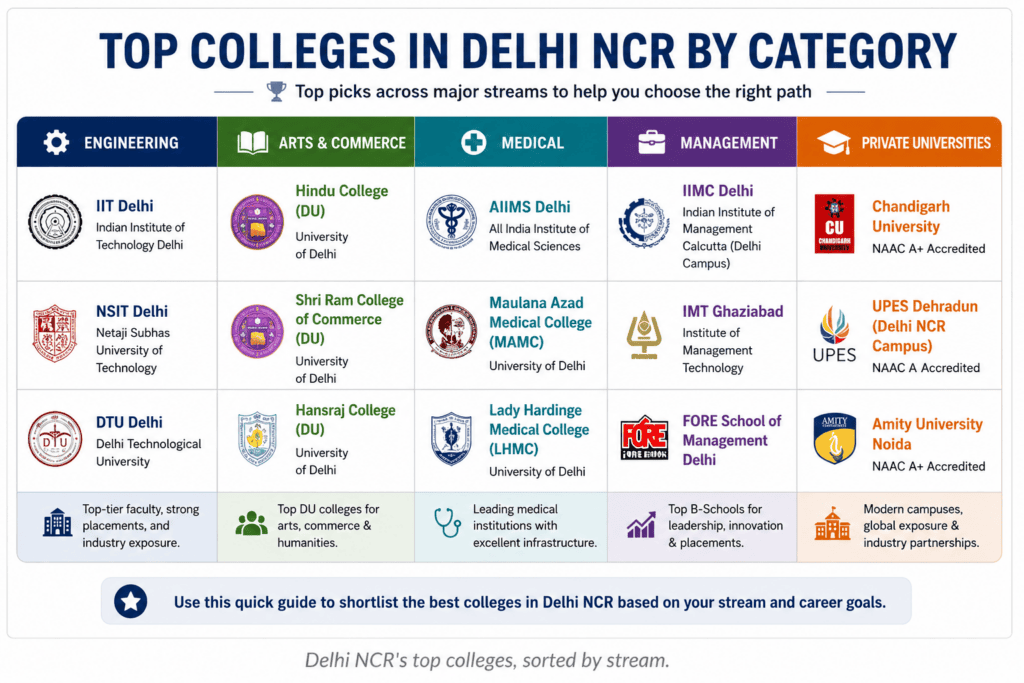
Delhi NCR has a lot of colleges. Too many, honestly, and that’s exactly the problem — how do you even start picking one? Engineering, medicine, commerce, arts, management, private universities… each of these has its own set of names that keep coming up again and again, colleges known for solid academics, decent placements, or just a campus life people actually talk about years later. So instead of throwing one giant list at you, here’s the category-wise breakdown — pick your stream, and go straight to what matters for you.
Engineering and Technology
Planning to go the engineering route? IIT Delhi is still the name everyone circles first, and for good reason — it’s held its place among the country’s top engineering institutes year after year. DTU comes right after it, and honestly, DTU’s placement game has gotten so strong lately that recruiters show up for it almost the way they do for the IITs. That’s not a small thing.
Then there’s NSUT and IIIT Delhi. Both deserve a proper look, especially if computer science or anything data-heavy is on your mind. IIIT Delhi, in particular, has spent the last few years building a real name for itself in AI and data science — it’s not just riding the trend, it’s actually invested in it.
Didn’t clear JEE Advanced? That’s fine, plenty of good engineers didn’t either. GGSIPU runs a bunch of solid affiliated colleges across Delhi, and if you look toward Noida and Greater Noida, private universities like Amity and Shiv Nadar have pumped serious money into expanding their tech programmes over the last few years.
Arts, Commerce, and Science (Delhi University Circuit)
This is probably where most Class 12 students start getting genuinely excited. DU’s college network is massive — we’re talking 90-plus colleges — so calling any single one “the best” feels a little unfair. Still, certain names keep coming up, again and again, in almost every conversation about DU.
Hindu College, for one, has held the top spot among DU colleges in recent NIRF rankings — strong academics, a culture that actually pushes research, not just lectures. Miranda House remains one of the most sought-after women’s colleges anywhere in the country, known for turning out sharp, well-spoken graduates. And then you’ve got the usual heavyweights: Hansraj, Kirori Mal, St. Stephen’s, LSR, and SRCC. Each one carries decades of reputation behind it, and SRCC especially has reached a kind of legendary status among commerce students.
One thing worth remembering, though — admission to all of these now runs through CUET-UG. So if you’re still thinking in terms of “what percentage do I need,” shift that thinking. It’s a CUET score conversation now, not a percentage one.
Medical Colleges
Let’s not overcomplicate this one. AIIMS Delhi is the top medical institution in the country, and it isn’t really a contest. It falls under the Ministry of Health & Family Welfare, and year after year, it holds its position as India’s best. Getting in, though? That’s a different story. NEET-UG is brutal — arguably the single toughest entrance exam a student in this country will ever sit for. Beyond AIIMS, Delhi still has strong options worth knowing: Maulana Azad Medical College and Lady Hardinge Medical College have both built solid, long-standing reputations of their own.
Management and Business
Thinking MBA or BBA down the line? Two names should already be on your radar — FMS Delhi (Faculty of Management Studies) and MDI Gurgaon. Both show up consistently among India’s best management institutes, and for good reason. At the undergraduate level, SRCC remains a heavyweight, and Amity University’s business school has carved out its own solid reputation too. Worth noting — a bunch of newer private universities in Noida and Gurugram have quietly built decent placement pipelines here as well, so don’t write them off just because they’re less talked about.
Private Universities Worth Watching
Here’s something worth sitting with: a “good college” doesn’t have to mean a government one anymore. That’s just where Indian higher education has landed. Amity University, Shiv Nadar University, and a few newer campuses in Gurugram and Faridabad have poured real money into infrastructure, industry tie-ups, and specialised courses in AI, cybersecurity, data science — the fields everyone’s chasing right now. If CUET or the big entrance exams didn’t go your way, these institutions genuinely open up a solid Plan B, especially for professional or skill-heavy courses.
Delhi vs Noida vs Gurugram — Does Location Even Matter?
Yes. More than most students expect going in, honestly. Delhi itself still holds the biggest cluster of legacy names — DU, JMI, IIT Delhi, AIIMS, all within the city. Noida has turned into private-university territory, especially strong in tech and management. Gurugram leaned hard into its corporate identity, which makes it a natural home for business-focused colleges with direct industry access.
If you’re commuting daily instead of staying in a hostel, this stuff isn’t just trivia — it’s real. A college that looks perfect on paper but eats two hours of travel each way, every single day, for four straight years? That wears a person down slowly. Check metro connectivity. Check traffic patterns at actual commute hours, not off-peak. Check hostel seats too, before you lock anything in.
Mistakes Students Keep Making
- Picking a big name over the actual course quality — a famous college with a weak department in your subject helps nobody.
- Trusting the “highest package” number colleges love to flash, instead of asking for the average, branch-wise.
- Never actually visiting campus or talking to a senior — websites and brochures don’t show you real campus life.
- Forgetting hidden costs. Hostel fees, transport, lab charges — they pile up fast and rarely make it into the glossy prospectus.
- Applying to just one or two colleges and hoping for the best. With CUET this competitive now, that’s just poor strategy.
The Admission Timeline You Shouldn’t Miss
Every year, a good number of strong students end up missing out on their first-choice college — not because their marks weren’t good enough, but because they missed a form deadline or misread an eligibility clause. Don’t let that be you.
Broadly, here’s how the admission cycle plays out for most Delhi NCR colleges:
- Board Results (May–June) – Your Class 12 marks become the baseline for eligibility checks across most streams.
- Entrance Exam Scores – CUET-UG results (for DU, JMI, and several central universities), JEE Main/Advanced (for engineering), and NEET-UG (for medicine) typically arrive between June and July.
- Application Window – Most colleges open online applications shortly after board results, often running parallel with entrance exam registration. Private universities usually keep rolling admissions open for longer.
- Counselling and Seat Allotment – This is where CUET and JEE candidates get matched to colleges based on preference lists and scores. Multiple rounds usually happen, so don’t panic if round one doesn’t go your way.
- Document Verification and Fee Payment – The final, slightly tedious, but absolutely non-negotiable step. Keep your documents ready well in advance — migration certificates, category certificates, and income proofs (if applicable) tend to cause last-minute stress.
A quick tip that saves a lot of heartburn: start tracking official websites and admission portals from April itself, rather than waiting for results. Dates shift, and colleges rarely resend reminders.
Government vs Private: A Quick Cost Comparison
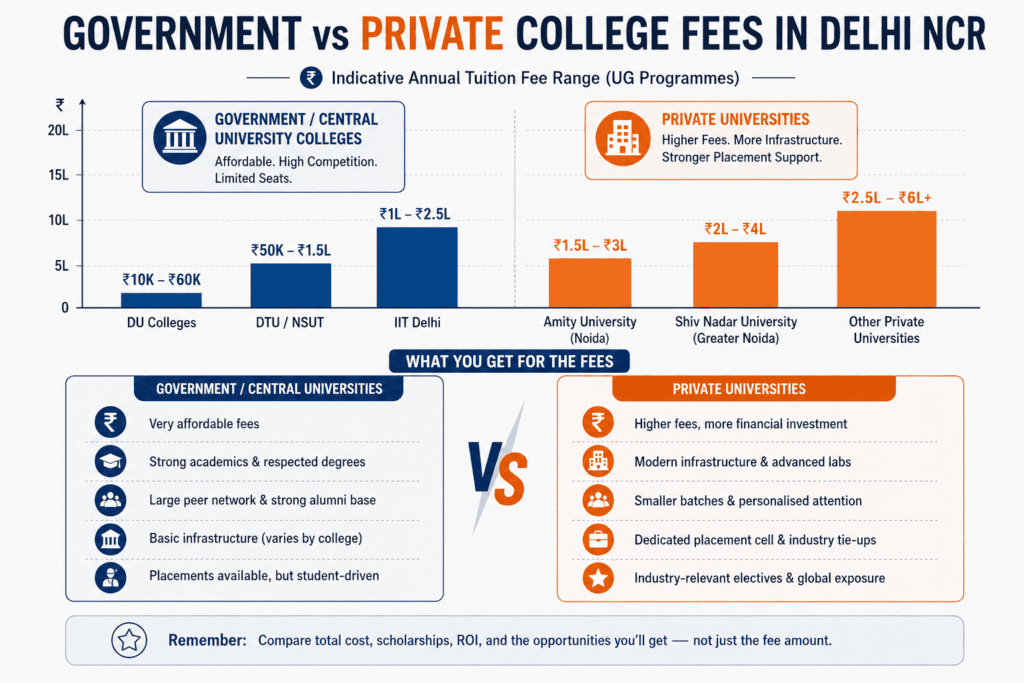
Money is, understandably, one of the biggest factors in this decision, so let’s talk numbers honestly. Government and central university colleges — DU colleges, DTU, NSUT, IIT Delhi — stay surprisingly light on the pocket. Compare the numbers and it’s almost funny: what a private college charges for one semester can cover an entire year at a place like DTU. Of course, that affordability comes at a price of its own. Seats are limited, and competition for them is brutal.
Private universities flip the equation. You pay more, sure, but that extra money usually goes somewhere — newer buildings, smaller batches, dedicated teams chasing placements on your behalf, and electives in fields that didn’t even exist as full courses a decade ago, like AI, cybersecurity, or data analytics. And here’s something a lot of students don’t realise until too late: scholarships aren’t rare at these institutions.
Merit-based waivers can knock a serious chunk off the fee for anyone with strong scores. So before writing off a college as “too expensive,” it’s worth actually checking what’s on offer. Sometimes the sticker price and the real price are two very different things.
There’s no universally “right” choice between the two paths. A government college with a lower fee and strong alumni network suits one type of student perfectly. A private university with modern labs and structured placement support suits another. What matters is being honest with yourself about which environment will actually help you to choose the best colleges in Delhi NCR.
A Simple Shortlisting Checklist
If you’re feeling overwhelmed by choice — and most students are, at this stage — try narrowing things down with a simple checklist rather than an endless spreadsheet:
- Shortlist 8–10 colleges based on your stream and realistic score range.
- Check NIRF ranking and NAAC accreditation for each.
- Compare average placement packages, not just the highest one advertised.
- Note the exact entrance exam or cutoff requirement for each college.
- Map out commute time or hostel availability for every option.
- Cross-check total cost, including hidden fees, for a full four-year estimate.
- Talk to at least one current student or recent alumnus, if you can manage it.
For choosing the best colleges in Delhi NCR, you need to run every college on your list through these seven points, and you’ll likely find your real top three emerging on their own — no guesswork required.
Scholarships and Financial Aid: Don’t Skip This Step
Here’s something that trips up way too many families: they see a fee number on a college website, wince, and cross it off the list. Just like that. Nobody stops to ask what support might actually be sitting there, unclaimed. Take Post-Matric Scholarships, for instance, or the National Means-cum-Merit Scholarship — both run by the government, both genuinely capable of bringing costs down for students who qualify, especially at government colleges.
Private universities across Delhi NCR aren’t sitting this out either. Most of them run their own scholarship programmes, usually tied to your board percentage or entrance exam score, sometimes to category reservations. And the range is wider than people expect — a modest 10% off tuition on one end, a full scholarship on the other, if your scores are strong enough.
Then there’s the loan route, which honestly doesn’t get talked about enough. Plenty of families financing a private university education now go through nationalised banks, and the interest rates on education loans for recognised institutions are usually reasonable. Some universities have even set up direct bank tie-ups, cutting out a chunk of the paperwork headache.
So before you write off a college purely on cost, do this one thing: spend twenty minutes on their financial aid page. That’s it. It might just flip your entire shortlist upside down.
Final Thoughts
Choosing among the best colleges in Delhi NCR isn’t really about finding some universal “number one” — it’s about finding the college that fits your goals, your budget, and honestly, your daily commute tolerance. Take the rankings seriously, but don’t let them make the decision for you. Talk to seniors, visit campuses if you can, and look closely at placement numbers for your specific course rather than the university as a whole.
Delhi NCR has more genuinely strong options than almost any other region in India. The real work now is matching one of them to where you actually want to go next.
Frequently Asked Questions
Q.1 Which college in Delhi NCR is actually the best?
Depends who you ask, honestly, and more importantly, what you’re studying. Engineering? IIT Delhi’s still the name everyone chases. Medicine, it’s AIIMS Delhi, no real competition there. For arts and commerce, Hindu College has been sitting at the top of the DU rankings lately. There’s no single crown here — just the right fit for your stream.
Q.2 Do I need to clear CUET to get into DU?
Yes, and there’s no way around it anymore. The old system, where your board percentage alone decided admission, is gone. CUET-UG now handles undergraduate entry at DU and a bunch of other central universities too.
Q.3 Should I even bother looking at Noida or Gurugram universities?
If your entrance scores aren’t quite landing you at the big government names, then yes, definitely look. A lot of the established private universities out there have genuinely solid infrastructure and real industry connections, particularly if you’re eyeing something newer like AI, data science, or cybersecurity. Don’t write them off just because they’re private.
Q.4 How much should I actually trust the NIRF ranking?
Fairly a lot, to be honest — it’s government-issued, methodology-driven, not just some random website’s opinion. But treat it as a starting point, not gospel. Cross-check it against placement numbers and how strong the specific course is before you finalise anything.
Q.5 How reliable is the NIRF ranking for choosing a college? It’s one of the more credible tools available, since it’s government-issued and methodology-based. That said, always cross-check it against placement data and course-specific reputation before making a final call.